
McDuffie County Criminal History Checks
There is no one-stop McDuffie County criminal history database. Begin with the record type and the event location. The Clerk of Superior Court holds adult court files, the Sheriff holds county incident and custody records, Thomson Police holds city reports, and the Georgia Crime Information Center links fingerprint-supported arrest cycles with reported outcomes.
Use a full legal name, date of birth and any former name or spelling variation. Those details help distinguish people with similar names, but a name match alone is not identity proof. Follow the source record through to its current outcome.
Choose the source by the question. A recent arrest calls for the arresting agency and jail. A filed felony calls for the Superior Court clerk. A city traffic or ordinance matter calls for Thomson Municipal Court. A public Georgia felony-conviction check calls for the state product, while a personal fingerprint review follows GBI instructions. When a search produces no hit, confirm the spelling, court and agency before treating silence as proof that no record exists.
- Identify whether the event began with the Sheriff, Thomson Police, another agency or a court filing.
- Check the relevant clerk or records counter using the person's name and, when accepted, date of birth.
- For a current detention question, call the McDuffie County Jail because no public roster is posted.
- Compare filed charges and the final disposition in the court file with any state criminal-history result.
- Request a certified disposition or fingerprint-based personal review when the use requires firm identity and official proof.
Three McDuffie Criminal Records Counters
The official Thomson-McDuffie government site shows why a vague instruction to visit the courthouse is not enough. Court records, jail records and city police records are split among three Thomson addresses.

The office that created a McDuffie County record is usually the best first stop, and each counter answers a different question.
Calling the correct counter first also prevents a routine McDuffie County criminal record request from being delayed or redirected between independent custodians.
Room 1401 is open weekdays from 8:30 a.m. to 5 p.m. for clerk work involving Superior, Magistrate and Juvenile matters, though juvenile files are not generally public. The Law Enforcement Center verifies current custody and takes sheriff-record requests. Thomson Police report pickup runs from 8:30 a.m. to 5 p.m. after allowing five business days. Municipal Court clerical work is at Main Street, but its sessions occur at 210 Railroad Street on the second Tuesday at 1 p.m.
Clerk, Room 1401
210 Railroad Street, Thomson, GA 30824
706-595-2134
Criminal desk: 706-595-2138
Law Enforcement Center
751 Public Safety Drive, Thomson, GA 30824
706-595-2040
Sheriff Records: 706-597-3862
Thomson Police
309 Main Street, Thomson, GA 30824
706-595-2166
Reports after five business days
Official Background Checks in Georgia
The Georgia Bureau of Investigation's Georgia Crime Information Center is the central repository. The Georgia Felon Search is the public route for in-state felony-conviction information using a full name, race, sex and date of birth. It is narrower than a subject's full fingerprint-identified history.
The GCIC overview explains the repository's role in collecting criminal-justice data. Its public material also makes clear that GCIC does not conduct ordinary name checks at its lobby.
For one's own broader record, or an authorized fingerprint purpose, use the route specified by GBI or the requesting agency rather than treating a public name result as complete.
McDuffie County agencies may provide a consent-based Georgia history and may set a local charge. Confirm the current product, consent requirement and amount before visiting. For a subject-only federal Identity History Summary, the FBI's electronic request route uses fingerprints and a separate federal fee. None of these products replaces the local court file when the goal is to read motions, orders or a certified disposition.
McDuffie Fingerprints Through IdentoGO GAPS
GBI moved the Georgia Applicant Processing Service to IDEMIA and IdentoGO on February 3, 2025. The current GAPS instructions are the right starting point because an agency service code or ORI and the reason for fingerprinting determine the enrollment path.
Applicants register, schedule and pay through the contracted system. Assistance is available at 833-542-9283, while the McDuffie Law Enforcement Center can answer local fingerprinting questions.
The Georgia IdentoGO enrollment portal handles the live workflow, not the county clerk.

Have the agency code and an accepted identity document ready before scheduling. A fingerprint result ties records to biometrics and answers a different question from Georgia Felon Search.
Kinds of McDuffie Criminal Records
One event can create several records, and later decisions can change the meaning of the first entry. McDuffie County criminal records should be read as connected files rather than as one permanent snapshot.
Warrant information can sit with Magistrate Court, the issuing court and the law-enforcement agency tasked with service. Probation and parole records divide again: adult felony supervision is state-run through DCS, while the State Board of Pardons and Paroles makes release decisions. The Georgia Sex Offender Registry is maintained by GBI, but the McDuffie Sheriff performs local registration and verification.
- Incident and arrest reports describe the agency response and alleged conduct.
- Booking records document intake, identifiers, charges, property and bond data at the jail.
- Court files track warrants, accusations or indictments, pleas, orders, judgments and sentences.
- GCIC histories connect submitted fingerprint arrests with dispositions reported back by justice agencies.
- Supervision and registry records address correctional custody, probation, parole or a legal registration duty.
McDuffie's Four-Record Arrest Chain
A McDuffie County arrest commonly produces four related records: an agency report, a jail booking, a prosecutor and court case, and a GCIC arrest cycle. The process reads: Incident or arrest report → county booking → filed charge and disposition → GCIC update.
The booking charge can differ from the charge ultimately accused or indicted. A dismissal or acquittal also does not make the initial report vanish. The McDuffie County court case lookup is the better route for the filed charge and judicial result, while the arrest page covers custody and report channels.
- Arrest
- A restraint based on alleged legal cause, not a finding of guilt.
- Disposition
- The result for a specific charge, such as conviction, acquittal, dismissal or nolle prosequi.
- Accusation
- A prosecutor's formal charging instrument used for qualifying cases.
- Indictment
- A grand jury's true bill that formally charges an offense.
McDuffie County Criminal Records: What They Contain
The fields depend on the record source. A clerk file is organized around a case and charge. A GCIC history is organized around identity-supported arrest cycles and reported results. A jail record focuses on custody.
| Name & identifiers | Legal name, aliases, date of birth, sex, race and agency identifiers when collected. |
|---|---|
| Arrest and booking | Arrest date, arresting agency, booking data, initial charges, bond and release status. |
| Charges | Offense wording, statute citation, count and later amended or filed charge. |
| Disposition | Result for each count, including plea, conviction, acquittal, dismissal or nolle prosequi. |
| Sentence | Custody, probation, fines or other terms stated in the judgment. |
| Status | Current county custody, GDC placement, probation, parole or registry information in its own system. |
Fixing a Missing McDuffie Disposition
A courthouse file may show a final result before it appears in a GCIC history. Georgia's Criminal Case Data Exchange tracks disposition transmission by offense tracking number and refreshes on a cycle, so the systems do not always update at the same moment.
The same lag can work in the other direction: a repository entry may show the arrest while the reader still needs the clerk file to learn what the prosecutor filed and what happened to each count. A booking label is not a substitute for an accusation, indictment or judgment. Match the arrest date, agency and tracking details before asking the clerk to locate the proper case.
GBI directs a person who finds a wrong or missing outcome to contact the court that handled the case. For a McDuffie Superior matter, call the criminal desk at 706-595-2138, inspect the adult file in Room 1401 and obtain a certified disposition if needed. The clerk can then address transmission of the correct outcome. This route fixes the source instead of trying to alter a jail or police report that did not decide the case.
Georgia Public Access Laws
The Georgia Open Records Act generally supports access to agency records, but court-sealed, juvenile and protected investigative material can be withheld. Criminal-history dissemination has separate rules, so an agency file and a GCIC product do not have identical access.
A narrowly written request helps the custodian locate a McDuffie County record and estimate copying or staff costs. State the incident date, place, agency, parties and specific document sought. Do not send a broad request to the combined city-county form when the Sheriff is the custodian; the research identifies a dedicated sheriff form. Court files go directly to the clerk rather than through a general administrative request.
Key Georgia laws:
O.C.G.A. §50-18-70 et seq. establishes the Open Records Act and the public-access policy for agency records.
O.C.G.A. §35-3-34 controls dissemination of Georgia criminal-history information, including the public felony-conviction route.
O.C.G.A. §35-3-37 governs record restriction and eligible charge cycles.
Georgia juvenile and court-sealing rules limit access even when other adult court files are open.
McDuffie Sheriff's Multi-Channel Request
The Sheriff is an independent custodian and is excluded from the county's general records route. Requests for a Sheriff incident, accident or other record go to the dedicated Records Division at 751 Public Safety Drive. The form accepts an event date and time, location, parties involved and a description of what is sought.
| Response choice | Practical detail |
|---|---|
| In person | Pickup requires identification. |
| Email or fax | Supply a clear return address or fax number. |
| Use the requester's mailing address on the form. | |
| Phone response | Include a working number for follow-up. |
The research found no posted local fee or guaranteed production date. Ask for an estimate. The Open Records Act calls for a response within three business days, though production may be scheduled later when records need review.
Restricted, Sealed & Expunged Records
Georgia uses the term record restriction. Restriction limits ordinary dissemination of an eligible charge cycle; it does not physically erase every file and is not a declaration that an event never occurred. A separate request may be needed to seal the court record.
Dismissal, no bill, nolle prosequi and certain other nonconviction outcomes may qualify under statutory conditions. Juvenile and already sealed files have their own limits.
Review the criminal history before starting so the arrest cycle and disposition can be identified. If the state history lacks the court result, obtain it from the McDuffie clerk first. A guilty disposition usually does not fit the simple dismissed-charge route, although Georgia law has other petition paths with exclusions. Current GBI forms and instructions control because eligibility turns on the date, result and offense.
For arrests after July 1, 2013, contact the prosecutor about an eligible restriction. For an earlier arrest, the applicant starts the GBI form with the arresting agency, which sends it to the prosecutor. A fully approved pre-2013 form goes to GCIC with the researched $25 state processing payment. First Offender treatment and a pardon are separate remedies.
No McDuffie Jail Roster Online
McDuffie County publishes no official online booking log or jail roster. For current custody, call the Law Enforcement Center and Jail at 706-595-2040. For an older booking or Sheriff report, use Records at 706-597-3862 and the dedicated request form. Unofficial jail aggregators are not a substitute for either channel.
After a sentenced person leaves county custody, the record route may shift. The GDC Find an Offender search covers qualifying state correctional records. The Georgia State Board of Pardons and Paroles offers separate parolee and tentative parole month tools.
The Parole Board gateway shows those statewide supervision routes.
Adult felony community supervision is handled by Georgia's Department of Community Supervision; the Thomson office is at 1025 Warrenton Highway and can be reached at 706-595-7404.
City-by-City Criminal Records in McDuffie County
McDuffie County has two incorporated places. Thomson has its own police and municipal court record routes. Dearing has no published town police, court or arrest portal, so a search starts with Town Hall to confirm the custodian and then moves to the Sheriff or the proper court.
Thomson Record Check
6,814 residents in the 2020 Census. City police reports and municipal cases use separate counters.
Dearing Record Check
529 residents in the 2020 Census. Confirm the agency before sending a town or county request.
How McDuffie Records Cross Agencies
Joint investigations show why one McDuffie County criminal history can have several custodians. A sheriff request can lead to a GBI investigation, a county booking, a Toombs Judicial Circuit prosecution and a state repository entry. Each office retains the part it created.
The official local courts gateway maps the courts that receive those cases.
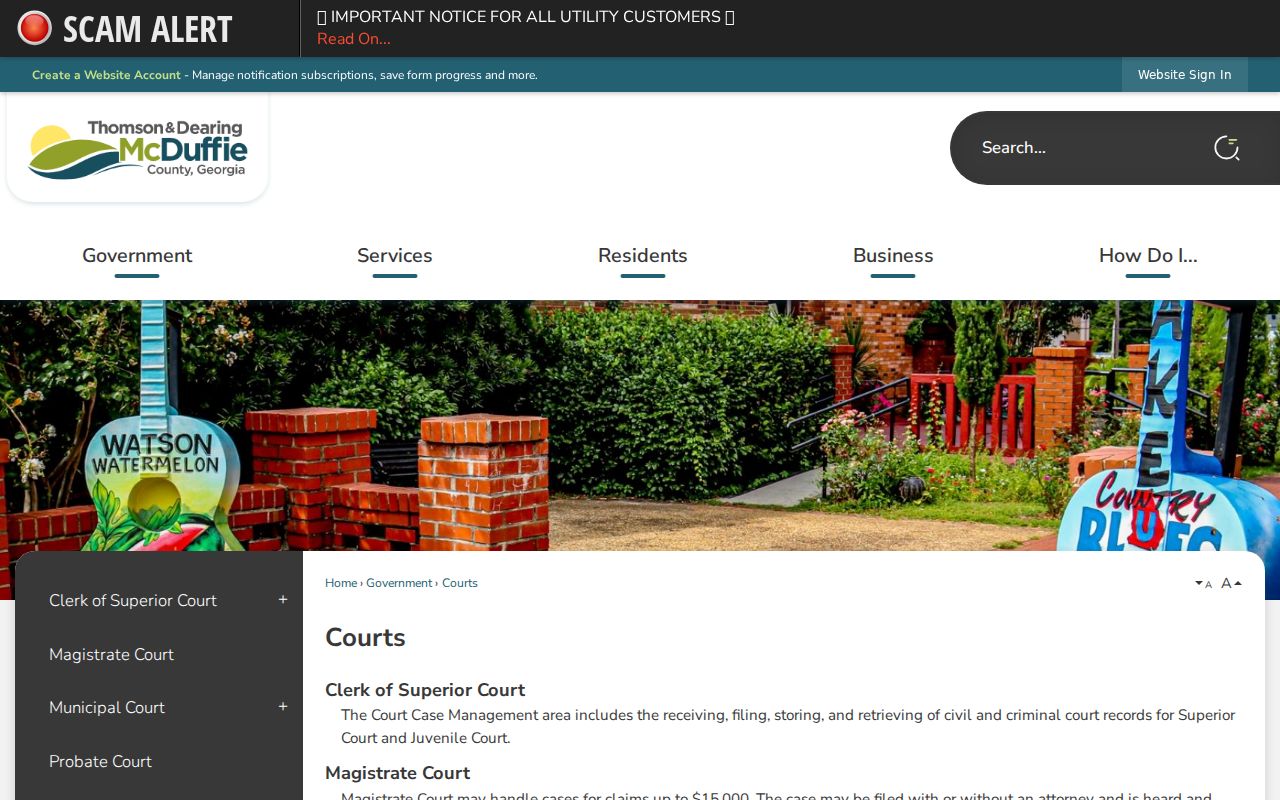
Superior Court handles felonies in the six-county Toombs Judicial Circuit. Magistrate Court handles warrants and early stages. Thomson Municipal Court handles city traffic, ordinance and qualifying misdemeanor matters, while federal prosecutions go to the Southern District of Georgia.
The GBI criminal-history FAQ explains how the state layer differs from those local files.
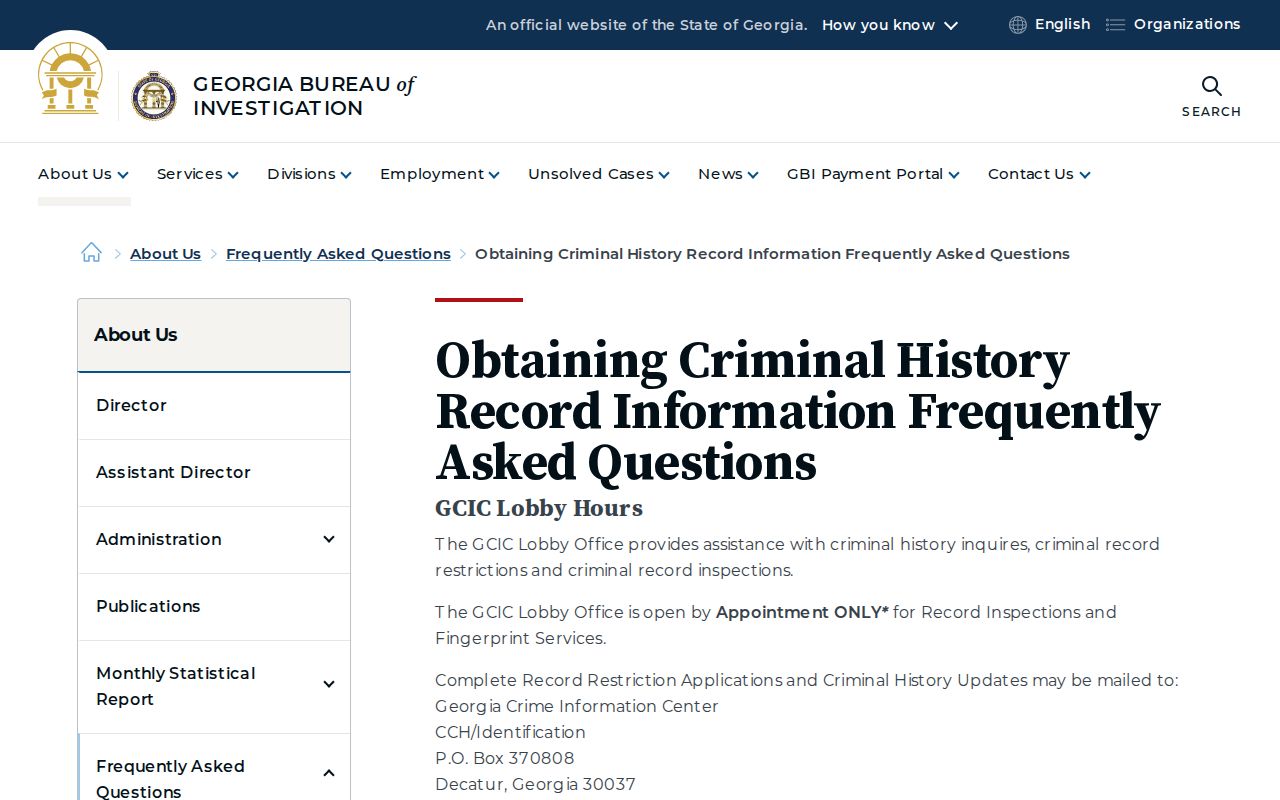
A sound McDuffie County check therefore follows the record chain, verifies identity and treats an arrest as an allegation unless a court record shows a conviction.